
Normal vs Emergency Lighting in NFPA Codes In life safety design, lighting does not function…
Fire Sprinkler Sample Testing: Is Your Contractor Testing the Right Sprinklers—or Just Selling You a Bigger Job?
“Your Sprinklers Are Too Old”—But What Does That Actually Mean?
Your annual fire sprinkler inspection is complete. Then the report arrives with a deficiency you have probably never seen before:
Fire sprinkler sample testing is due.
The contractor may tell you that your sprinklers are 20, 25, or 50 years old. They may offer to remove several sprinkler heads and send them to a laboratory. Or they may recommend replacing hundreds—possibly thousands—of sprinklers throughout the building.
Your first reaction is reasonable: Why am I paying to test sprinklers that have never leaked, discharged, or caused a problem?
Your second question may be less comfortable: Does fire code actually require this, or is someone trying to upsell me?
Those questions matter because sprinkler sample testing is legitimate, but contractors can explain it badly or scope it incorrectly. A vague note saying “test four sprinkler heads” does not prove that four is the correct number. A statement that “all the sprinklers are too old” does not prove that every sprinkler is the same type or age.
Before you accept a recommendation to replace sprinklers throughout the building, ask which sprinklers have reached a testing threshold and what laboratory testing could establish.
Why Building Age Alone Does Not Answer the Question
This issue increasingly affects owners and property managers responsible for aging commercial and industrial buildings throughout Metro Detroit and Southeast Michigan. Over several decades, owners have expanded, renovated, reconfigured, or converted many of these properties. Those changes often leave several sprinkler populations that no one can evaluate accurately from the building’s age alone.
Older commercial buildings rarely contain one perfectly uniform population of sprinklers. The original system may have standard-response uprights in concealed spaces. A later office renovation may have introduced quick-response pendents. A loading dock could have dry sprinklers exposed to freezing conditions. An addition may contain sprinklers made by a different manufacturer. A warehouse area could contain ESFR sprinklers with a different testing interval than the office sprinklers nearby.
That is why proper fire sprinkler sample testing is not simply:
- Find four accessible sprinkler heads.
- Remove them.
- Mail them to a laboratory.
The difficult part comes first: identifying what is installed, determining which NFPA 25 edition applies, defining the population each sample will represent, and selecting a defensible sample from that population.
If your contractor cannot explain those four points, you do not yet have enough information to approve the work.
What Is Fire Sprinkler Sample Testing?
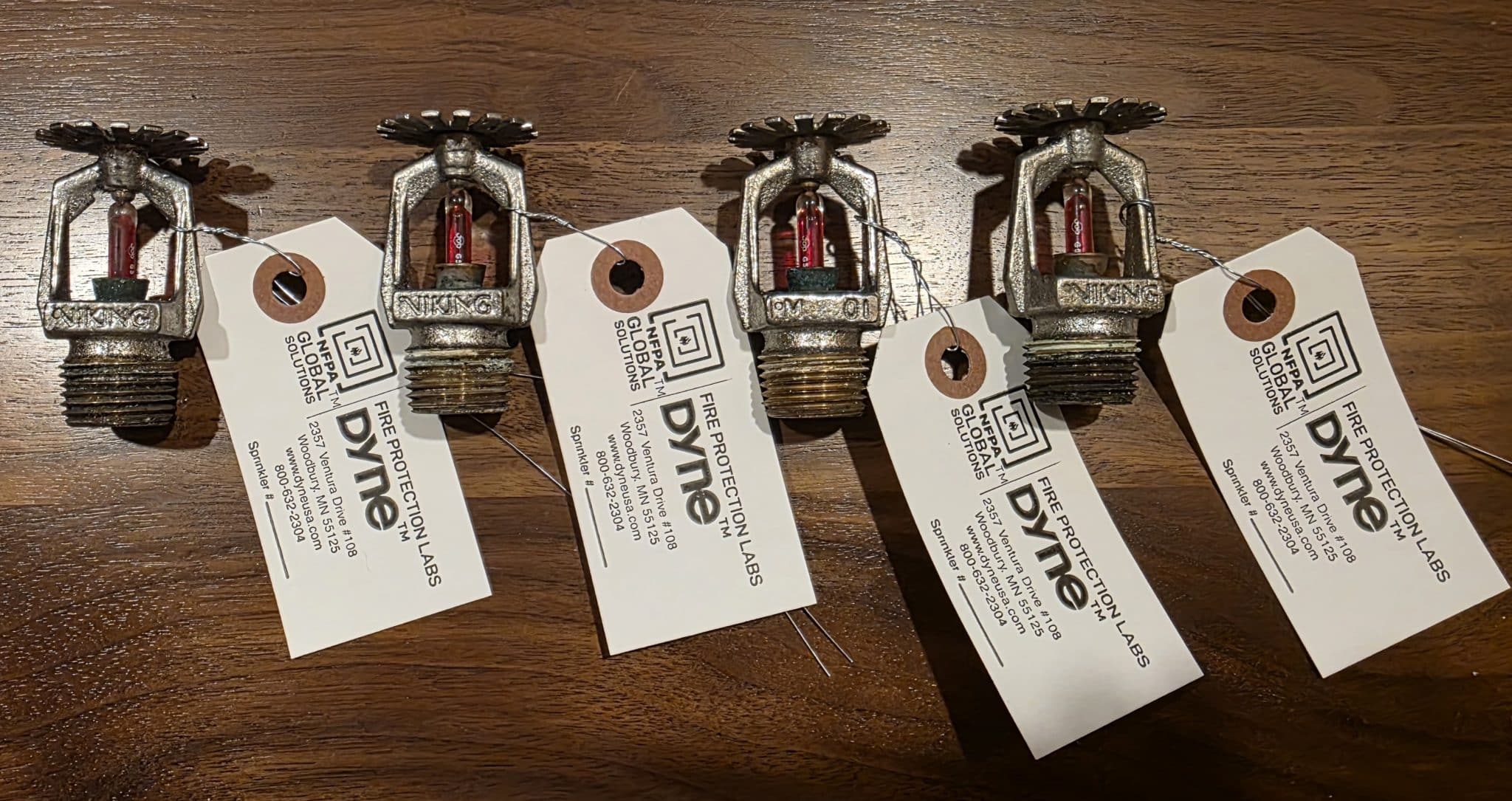
During fire sprinkler sample testing, a contractor removes representative sprinklers from an existing system and sends them to a recognized laboratory that the authority having jurisdiction (AHJ) accepts. The laboratory tests whether those sprinklers still operate properly. The contractor installs new listed sprinklers in the open fittings, restores the system, and uses the laboratory results to evaluate the sprinkler population that the samples represent.
NFPA 25 generally gives the owner two choices after a sprinkler population reaches the applicable age or service-condition threshold: replace the affected sprinklers or test representative samples. The deadline depends on the sprinkler type, its operating environment, and the NFPA 25 edition that governs the property.
Common Testing Deadlines
Under the NFPA 25 (2023) framework, common initial deadlines include 5 years for sprinklers in harsh environments and certain extra-high-temperature solder-type sprinklers; 20 years for dry sprinklers and fast-response ESFR or CMSA sprinklers; 25 years for most other fast-response sprinklers; and 50 years for general sprinklers. The standard then assigns the applicable retesting interval. Once general sprinklers reach 75 years, they move to a 5-year testing cycle.
However, NFPA 25 does not automatically become law everywhere merely because NFPA publishes it. State or local code adoption, AHJ direction, and sometimes insurance or contractual requirements determine what the property must follow. Older adopted editions use different deadlines. For example, the 2014 edition starts dry-sprinkler testing at 10 years and fast-response sprinkler testing at 20 years. Therefore, the contractor should verify the governing edition before declaring your building overdue.
How Fire Sprinkler Sample Testing Works
NFPA 25 Does Not Give Every Sprinkler the Same Deadline
The phrase “your sprinklers are old” is not a sufficient code analysis. The first testing or replacement deadline depends on the sprinkler’s design, response classification, environment, age in service, and the NFPA 25 edition that governs the property.
The following comparison shows why the edition matters:
| Sprinkler category | NFPA 25 (2014) | NFPA 25 (2023) framework |
|---|---|---|
| General sprinklers | At 50 years; every 10 years thereafter | At 50 years; every 10 years thereafter |
| General sprinklers at 75 years | Every 5 years thereafter | Every 5 years thereafter |
| Fast-response sprinklers | At 20 years; every 10 years thereafter | At 25 years; every 10 years thereafter, except ESFR and CMSA |
| Fast-response ESFR and CMSA sprinklers | Included in the 20-year fast-response rule | At 20 years; every 10 years thereafter |
| Dry sprinklers | At 10 years; every 10 years thereafter | At 20 years; every 10 years thereafter |
| Sprinklers in harsh environments | Every 5 years | Every 5 years |
| Certain extra-high-temperature solder-type sprinklers exposed to sustained high ambient temperatures | Every 5 years | Every 5 years |
Do not use this table to diagnose a building from its construction year alone. Instead, use it to frame the questions your contractor should investigate.
What Applies to a Michigan Property?
NFPA 25 is a nationally recognized standard, but the newest edition does not automatically govern every building as soon as NFPA publishes it. For a Michigan property, the contractor must determine which edition and requirements apply through the adopted code, the authority having jurisdiction, and any applicable insurance or contractual requirements.
That local determination matters because the edition can change the date on which a sprinkler population becomes due. For example, a dry sprinkler that reaches 10 years in service could be due under the 2014 framework but not reach its initial age threshold until 20 years under the 2023 framework. A contractor should not quote a major testing or replacement project without being able to identify the technical basis used.
The enforcing authority also depends on the property’s location. Within Detroit, the Detroit Fire Marshal’s Fire Prevention Division conducts life-safety inspections and enforces the City’s adopted codes. The appropriate local authorities oversee properties elsewhere in Wayne, Oakland, Macomb, and the surrounding Southeast Michigan counties. No single “Metro Detroit fire marshal” governs the entire region.
For an owner, the practical questions are:
- Which NFPA 25 edition or other governing requirement is being applied?
- Who is the AHJ for this property?
- Which sprinkler category and installation date trigger the recommendation?
- Is the contractor describing the current edition, the locally adopted edition, or both?
An honest recommendation should answer those questions before the contractor treats an entire population as overdue.
Special Sprinkler Categories That Need Careful Identification
For example, ESFR sprinklers are fast-response sprinklers, but the 2023 edition treats fast-response ESFR and CMSA sprinklers as a separate age-testing category. That distinction matters because the general fast-response threshold increased to 25 years while ESFR and CMSA remained at 20 years.
Dry sprinklers also require careful identification. A “dry sprinkler” is a specific listed sprinkler assembly with a sealed dry barrel, commonly installed where part of the sprinkler is exposed to freezing temperatures. It is not the same thing as every sprinkler connected to a dry-pipe system. A standard upright sprinkler installed on dry-system piping is not automatically a listed dry sprinkler.
Michigan’s climate makes that distinction especially relevant. Across Metro Detroit and Southeast Michigan, contractors commonly find dry sprinklers at exterior canopies, loading docks, parking structures, unheated warehouses, walk-in freezers, and other spaces subject to freezing. These assemblies differ from sprinklers inside a heated office in both construction and service conditions. For that reason, NFPA 25 assigns dry sprinklers a separate age-based testing or replacement interval. Michigan winters do not change the stated NFPA interval, but they make correct identification of dry sprinklers a frequent and important field issue.
Finally, when reliable installation records do not exist, NFPA 25 annex guidance has historically pointed to the sprinkler’s manufacturing date as the basis for estimating its in-service interval. That is one reason technicians photograph frame and deflector markings and record the sprinkler identification number, or SIN, whenever it can be read.
Age-Based Testing Is Different From Replacing an Obviously Deficient Sprinkler
Sample testing evaluates sprinklers that appear suitable to remain in service but have reached a periodic testing threshold. It does not cure a sprinkler that already has an observable replacement condition.
Sprinklers showing conditions such as the following generally require replacement rather than inclusion in a routine age-based sample:
- Leakage
- Mechanical or physical damage
- Field-applied paint
- Severe corrosion
- Severe loading or foreign material
- A missing or damaged operating element
This distinction protects the integrity of the test. If a contractor deliberately selects four visibly damaged sprinklers from an otherwise clean population, that choice biases the sample toward failure. If the contractor selects only the four cleanest and newest-looking sprinklers, that choice may bias the sample in the other direction.
The purpose is not to find sprinklers most likely to pass or fail. The purpose is to select sprinklers that fairly represent the population being evaluated.
Why Sprinklers Can Become Less Reliable Over Time
A sprinkler is a thermally operated mechanical valve. Under normal conditions, a cap or seal holds water back at the sprinkler orifice. A heat-responsive element—commonly a glass bulb or fusible-link assembly—restrains that seal. When the element reaches its operating condition, it releases, the water seal clears, and water discharges against the deflector to create the listed spray pattern.
Several physical mechanisms can interfere with that sequence.
Loading and paint can insulate the thermal element
Dust, fibers, grease, overspray, or other deposits add material around the sprinkler’s heat-responsive components. That material can act as insulation or add thermal mass, slowing heat transfer from the surrounding air into the operating element.
Field-applied paint can be even more serious. In addition to insulating the thermal element, paint can bond moving parts, bridge clearances, alter the deflector, or interfere with the release of the cap and seal. Factory-applied finishes and listed corrosion-resistant coatings are evaluated as part of the sprinkler’s listing; paint applied in the field is not.
Corrosion can attack both the operating mechanism and the waterway
External corrosion can restrict moving interfaces or weaken components. Internal corrosion products can accumulate at or behind the water seal. Even when the thermal element releases on time, the sprinkler can still fail if the seal does not release or the waterway remains obstructed.
Corrosive atmospheres accelerate these risks. NFPA 25 therefore assigns a much shorter testing/replacement cycle to sprinklers in harsh environments. Examples can include locations exposed to chemical vapors, salt, weather, moisture, industrial processes, or chemically aggressive water supplies.
Fusible elements can change under sustained heat
Some sprinklers use a soldered or fusible-alloy element. Long-term exposure to elevated ambient temperature can contribute to creep or migration of the alloy. That can alter the element’s operating characteristics. This is the technical reason certain extra-high-temperature solder-type sprinklers exposed to semicontinuous or continuous maximum allowable ambient temperatures are placed on a 5-year cycle.
Glass bulbs and seals can fail mechanically
A glass-bulb sprinkler depends on the integrity and fill of the bulb. Loss of fluid or damage can prevent the expected operation. Other sprinkler designs can experience sticking at sliding seals or O-rings after long service.
These are not always conditions a technician can conclusively evaluate from the floor. A sprinkler may look acceptable during an annual fire sprinkler inspection while its thermal response or internal release mechanism has degraded. Laboratory testing addresses that uncertainty.
What “Response Time” Means
Sprinklers do not all react to heat at the same speed. Engineers commonly describe thermal sensitivity with a Response Time Index (RTI). RTI relates the operating element’s thermal inertia to the velocity and temperature of the heated air moving around it. In practical terms, a lower RTI identifies a more thermally responsive element under defined test conditions.
That does not mean the laboratory simply heats the sprinkler until it opens and calls every opening a pass. The laboratory exposes the sprinkler to controlled temperature and airflow conditions. It then compares the measured operating time with the criteria for that sprinkler’s response classification and test method.
The laboratory is answering two related questions:
- Sensitivity: Did the sprinkler operate within the allowable time under the defined heat and airflow exposure?
- Functionality: After the operating element released, did the seal release and did the waterway clear as required?
A sprinkler can therefore fail even if the glass bulb breaks or the fusible element separates. If the water seal remains stuck, the sprinkler still has not functioned correctly.
How a Proper Sample Is Selected
NFPA 25 establishes a minimum sample size, but calculating that minimum requires a defensible sample definition.
Under the 2014 edition, Section 5.3.1.2 required at least four sprinklers or 1% of the sprinklers in the individual sample, whichever was greater. Its annex guidance indicated that, within the same environment, similar sidewall, upright, and pendent sprinklers from the same manufacturer could be considered part of one sample, with additional sprinklers included when another manufacturer was represented.
Newer language continues to center the calculation on a defined sample area and requires the applicable sprinkler types and manufacturers to be represented. The practical lesson is the same: four is a minimum, not an automatic total for every building.
Consider a property containing:
- 180 Tyco quick-response pendents in renovated offices
- 65 Reliable quick-response uprights above ceilings
- 12 dry sidewall sprinklers at exterior loading areas
- 220 standard-response uprights in the original warehouse
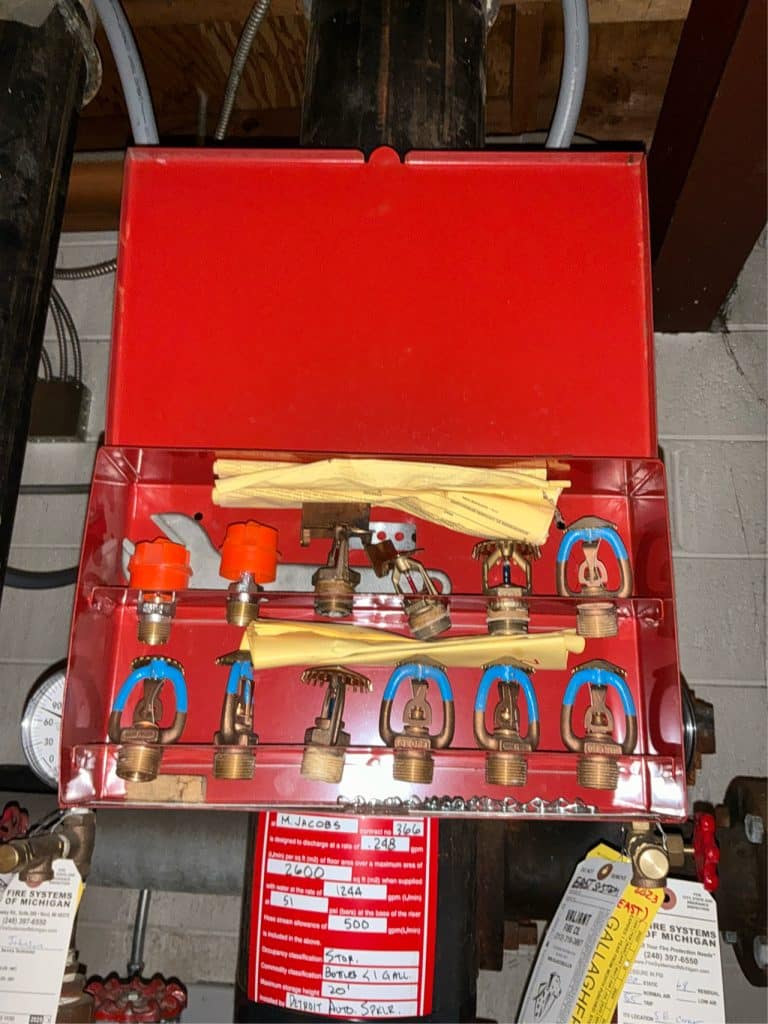
Those sprinklers do not form one indiscriminate pile from which the four easiest heads should be selected. They differ in manufacturer, construction, response/application, environment, and possibly installation date. The contractor must determine which groups have reached a testing threshold and what each laboratory sample is intended to represent.
What the Field Survey Should Document
The survey should document, where determinable:
- Manufacturer
- Model or SIN
- Response and application classification
- Orientation and construction
- Temperature rating and thermal element
- K-factor
- Finish or listed coating
- Approximate installation era
- System, floor, room, or area served
- Approximate quantity in the represented population
- Service environment
- Prior sample-testing or replacement history
This is also why sample quantities are not determined “per branch line.” NFPA 25’s sample-testing rule is not a blanket instruction to take four sprinklers from every branch line. Branch-line location may matter when selecting a geographically representative set, but it is not itself the universal multiplier. An honest scope defines the sample area or population first, then applies the minimum quantity and representation rules required by the governing edition.
Sample-Area Strategy Can Materially Change the Owner’s Risk
There is more than one defensible way to define a sample area. NFPA 25 establishes what a representative sample must contain and what happens after a failure, but it does not prescribe one universal sample-area map for every property.
That creates an important planning decision for the building owner and contractor:
Do we use one broad sample area and perform fewer tests now, or divide the property into smaller, technically defensible sample areas so a future failure affects a smaller population?
The answer can make an enormous financial difference.
High-Rise Example: One Building-Wide Sample or One Sample per Floor?
Assume a 20-story high-rise in Detroit contains substantially similar sprinklers installed during the same construction period. One option may be to treat the entire tower as one sample area. That may reduce the number of sprinklers sent to the laboratory. But if one sprinkler in that representative sample fails, the replacement consequence could extend to every sprinkler represented throughout the tower.
Another option may be to establish each floor as its own sample area. Each floor would have its own representative sample and laboratory result. If the sample from Floor 12 failed while the other floors passed, the required replacement would generally be limited to the sprinklers represented by the Floor 12 sample—not all 20 floors.
That does not make floor-by-floor sampling free. If every floor is a separate sample area, the minimum sample quantity applies to every floor. The owner pays for more replacement sprinklers, more laboratory tests, and potentially more field labor at the outset. The benefit is risk containment: one failed sprinkler is less likely to trigger a tower-wide replacement.
Testing Cost Versus Replacement Exposure
The decision can be viewed as a tradeoff:
| Sampling approach | Initial testing cost | Population exposed if one sample fails |
|---|---|---|
| One sample area for the entire high-rise | Usually lower | Potentially every sprinkler represented throughout the building |
| One sample area per floor | Higher | Generally the represented sprinklers on the failed floor |
| Sample areas grouped by riser or system | Moderate, depending on layout | The represented sprinklers served by the affected riser or system |
| Sample areas based on installation phase or renovation era | Moderate, depending on records | The represented sprinklers from the affected phase or renovation |
| Sample areas based on environment | Moderate to higher | The affected office, garage, pool, exterior, freezer, or corrosive area |
Floor-by-floor testing is therefore not automatically the “best” answer. In some towers, several floors may be genuinely similar and served by the same system. In others, floors were renovated in different decades, contain different manufacturers, or have different occupancies and environmental exposures. A parking level, commercial kitchen, pool area, loading dock, mechanical floor, and typical office floor should not be grouped merely because they share a street address.
Other Defensible Ways to Define Sample Areas
Other legitimate sample-area strategies can include:
- By floor: Useful when the owner wants to isolate replacement exposure by story.
- By riser or sprinkler system: Useful when system boundaries provide clear field identification and shutdown planning.
- By building section or addition: Useful when original construction and later additions have different installation histories.
- By renovation era: Useful when tenant improvements introduced distinct sprinkler populations at known times.
- By occupancy or environment: Useful when offices, warehouses, garages, pools, freezers, exterior canopies, or corrosive process areas experience different conditions.
- By sprinkler population: Useful when a clearly identifiable manufacturer, model, response type, or construction should be evaluated separately.
Smaller sample areas can reduce the financial consequence of failure, but they must be established before the samples are submitted and documented clearly enough that the laboratory results can be traced back to the sprinklers they represent. A contractor should not wait for a failure and then retroactively claim that the failed sprinkler represented only one convenient room or floor.
The areas also cannot be divided arbitrarily to manufacture a favorable result. The selected sprinklers must remain representative of the population in each area, and the sampling plan must account for the sprinkler types and manufacturers required by the governing edition. The appropriate strategy balances:
- The number and cost of samples now
- The potential replacement exposure after a failed test
- Differences in environment and installation history
- The owner’s tolerance for financial risk
- Available records and confidence in field identification
- The practicality of system shutdowns and access
- AHJ expectations
This is where a contractor can provide value well beyond removing sprinklers. A knowledgeable contractor should present the owner with reasonable sampling options, explain the cost and risk of each, and document the option the owner selects.
What Happens in the Building
Once the sampling plan is established, the field work normally includes:
- Coordinating access, shutdown timing, notifications, and impairment procedures.
- Identifying the exact sprinklers to be removed.
- Closing the appropriate control valve and draining the affected system safely.
- Removing the selected sprinklers with the correct sprinkler wrench.
- Installing new, listed replacement sprinklers compatible with the system design.
- Replacing or correctly reinstalling escutcheons or cover arrangements as applicable.
- Restoring the system, checking for leakage, reopening valves, and returning alarms or supervisory equipment to service.
- Tagging each removed sprinkler so the laboratory result can be traced back to its represented population and location.
- Packaging the sprinklers to prevent shipping damage.
- Submitting the samples and documentation to the recognized laboratory.
The contractor does not return sprinklers removed for destructive field-service testing to their original outlets. Instead, the contractor installs new sprinklers during the shutdown and restores the system while the laboratory evaluates the samples.
The impairment itself must also be managed. Draining a sprinkler system takes fire protection out of service for part of the building. The contractor and owner should coordinate notifications, precautions, restoration, and any AHJ or insurance requirements that apply to that impairment.
What the Laboratory Does
At the laboratory, staff log each sample so every sprinkler remains associated with the correct customer, property, sample group, and location. The laboratory records identifying information and observable conditions.
For the performance portion of the test, laboratory staff mount and pressurize the sprinkler in controlled test equipment. They expose it to defined heated-air temperature and velocity conditions and measure how long the operating element takes to release. Then they compare the result with the allowable response criteria for that sprinkler classification.
The laboratory also confirms functionality. NFPA 25 annex guidance describes verifying that the waterway clears during sensitivity/functionality testing at 5 psi or at the minimum listed operating pressure for dry sprinklers. A failed result can therefore arise from:
- Excessive response time
- Failure of the thermal element or release mechanism to activate
- Failure of the cap or water seal to release
- A blocked waterway
- Loss of pressure not being detected because flow did not occur
Some laboratory reports also include post-test photographs of the waterway, helping document an obstruction or release problem. The final report identifies the samples, records the individual results, and states whether each sprinkler passed or failed the applicable test criteria. A qualified contractor then connects those results back to the population documented in the field.
What Happens If the Sample Passes—or Fails
If the representative sample passes, the sprinklers represented by that sample can generally remain in service until the next required testing interval, provided they do not have separate inspection deficiencies.
A passing laboratory report does not legalize a painted, damaged, leaking, severely corroded, obstructed, or improperly installed sprinkler. Those conditions remain separate.
If one sprinkler within a representative sample fails, NFPA 25 requires replacement of the sprinklers within the area represented by that sample.
That does not automatically mean every sprinkler in the building must be replaced. It means the consequence follows the sample definition. If the sample was documented as representing a specific office renovation, the result applies to that represented area or population. If the contractor combined unrelated sprinklers into an undefined sample, determining the extent of required replacement becomes much more difficult.
Good sample planning is therefore not paperwork for paperwork’s sake. It controls the technical meaning—and potentially the financial consequence—of the laboratory result.
How to Review a Fire Sprinkler Sample-Testing Quote
An honest contractor should be able to explain the scope before asking you to approve it. You should not need an engineering degree, but the quote should contain enough detail for you to understand what is being tested, why it is due, and what your money covers.
What a credible quote should identify
Look for:
- The applicable basis: The sprinkler category, age, environment, and NFPA 25 edition or AHJ requirement used to establish that testing is due.
- The represented population or sample area: The system, floor, tenant area, warehouse section, addition, exterior exposure, or other defined area represented by each sample.
- The sampling strategy: Whether the property is being sampled as one building, by floor, by riser/system, by installation phase, by environment, or by another defensible grouping—and why that option was selected.
- The sprinkler information: Manufacturer, model/SIN when readable, response/application, orientation or construction, temperature rating, and approximate population.
- The sample calculation: At least four or the applicable 1% calculation, whichever is greater, with additional representation required by the governing edition and the installed populations.
- The replacement sprinklers: Quantity and type of new sprinklers installed where samples are removed.
- Field labor: Shutdown, drain-down, removal, installation, system restoration, and leak checking.
- Laboratory charges: Testing fees, sample groups, shipping, handling, and any rush charge.
- Access and operational costs: Lift rental, ceiling access, after-hours work, security coordination, tenant notifications, impairment precautions, or fire-watch requirements when applicable.
- Deliverables: The laboratory report and a clear explanation of which installed sprinklers each result represents.
- Failure handling: A statement that a failed result will lead to a separate replacement scope or proposal for the represented area—not an undefined blank check.
Pricing should follow the actual work—not a mystery “per-head” number
The price normally has several components:
- Investigation and sample planning
- Field labor to impair, drain, replace, and restore the system
- New replacement sprinklers and related materials
- Laboratory testing and shipping
- Access or special-condition costs
A low laboratory fee does not mean the entire project should be inexpensive. In many buildings, the field shutdown, access, draining, replacement work, and restoration require more labor than the laboratory test itself.
The reverse is also true: a large price is not justified merely because “NFPA requires it.” The contractor should show how many samples are being submitted, what each represents, how the count was determined, and what site conditions drive the labor.
Red flags that deserve another question
Be cautious if:
- The inspection report says only, “Sample testing due—test four heads.”
- Nobody documented manufacturer, model, response type, location, or approximate quantity.
- The contractor assumes every sprinkler is the same age as the building.
- Four convenient sprinklers are selected from unrelated areas or sprinkler types.
- The quote multiplies four sprinklers by every branch line without explaining why.
- Visibly painted, damaged, leaking, or severely corroded sprinklers are being used as the age-test sample.
- The contractor recommends replacing the entire building but cannot define the affected population.
- The contractor never discusses whether smaller sample areas could reasonably limit the owner’s replacement exposure.
- The proposal uses a single building-wide sample without explaining what happens if one sprinkler fails.
- The quote does not say who receives the laboratory report.
- The contractor cannot explain what happens if one sample passes and another fails.
- The proposal cites “NFPA 25” without identifying whether an older adopted edition changes the deadline.
The most honest answer may be: “We need better information before final pricing.”
In an older or repeatedly renovated building, a technician may not be able to identify every sprinkler population during one routine floor-level inspection. Markings may face away from view. Concealed spaces may be inaccessible. Tenant areas may be locked. Records may be incomplete.
That uncertainty should be disclosed—not hidden inside an arbitrary allowance or treated as proof that the whole building needs replacement.
A responsible contractor may recommend a focused survey before issuing the final sample-testing proposal. That additional investigation can save money by preventing unnecessary samples, avoiding repeat shutdowns, and ensuring a failed result is tied to a clearly defined population instead of an entire building by default.
The objective is not to remove the fewest sprinklers or sell the most replacements. It is to create a technically defensible sample that gives the owner a reliable answer at a fair cost.
Need an Honest Sprinkler Sample-Testing Review in Southeast Michigan?
If your inspection report says sprinkler sample testing is due, Valiant Fire Company’s sprinkler specialists can review the installed sprinkler information, identify what remains unknown, develop the sampling plan, coordinate the field and laboratory work, and explain exactly what the results mean for your property.
We help commercial building owners, property managers, and facility teams throughout Metro Detroit and Southeast Michigan, including properties across Wayne, Oakland, and Macomb counties. Our objective is to determine what is actually due, define the financial consequences before testing begins, and give the owner a defensible course of action—not use an age-based deficiency as a shortcut to an unnecessary building-wide replacement.
Have you been told that your building’s sprinklers are too old and must be tested or replaced? Request a fire sprinkler sample-testing review before approving an undefined replacement or “four-head” testing scope.
Related Posts